





What are some powerful tools for trading trends or detecting reversals of trends? A Wedge pattern forex is one of them.
Identifying all the different variations of a wedge pattern and landing the perfect wedge strategy is no easy task.
In this ultimate guide to Forex wedge patterns, you’ll learn everything you need to know. The wedge is slightly different from the other patterns in Forex trading because it appears mid-trend and can be either a continuation or reversal.
What is a wedge?
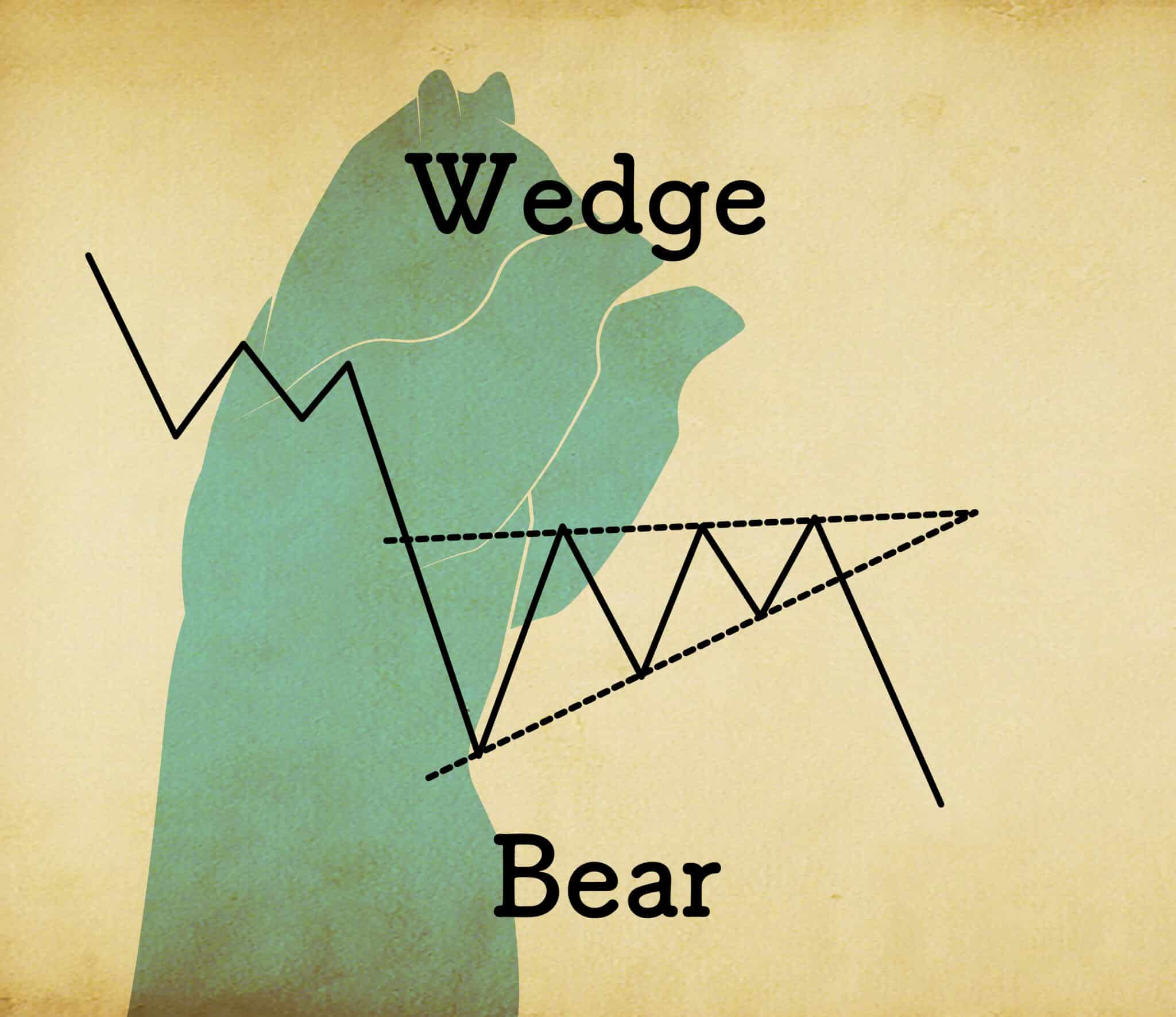
Convergent trend lines mark the wedge pattern on a price chart. Each trend line runs between the highs and lows of a price series throughout ten to fifty periods. As the lines approach a convergence, the highs and the lows fall or rise at different rates, creating the appearance of a wedge.
A wedge-shaped trend line is considered helpful by technical analysts as an indicator of price reversals.
What is a wedge pattern?
Market wedges occur when a market has been pushed in one direction and then stalls while trading in a range channel, narrowing over time. Each session’s bars are slowly shrinking until the market breaks out. It is pretty easy to distinguish wedges based on their shape.
Lows are rising, and highs are falling. These patterns can be rare on higher timeframes but are powerful to spot. If you spot one of these patterns, you have a good chance of landing a solid breakout trade, and we have some tips on maximising your results over time.
Understanding the wedge pattern
The wedge pattern can indicate either a bullish or bearish price reversal. Regardless of the interpretation, there are three characteristics that this pattern shares:
- The converging trend lines.
- The declining volume as the price progresses through the pattern.
- The breakout from one of the trend lines.
There are two types of reversals in the wedge pattern: a rising wedge (signifying a bearish trend reversal) and a falling wedge (signifying a bullish trend reversal).
What is the rising wedge chart pattern?
The rising wedge appears as a chart pattern when two converging resistance and support lines converge. For a rising wedge to form, both support and resistance levels must point upwards, and the support level must be steeper than the resistance level.
A wedge is often followed by a breakout, like a head-and-shoulders pattern, triangles, and flags. This breakout is often bearish for rising wedges.
A rising or falling market can cause ascending wedges:
- Markets in an uptrend signal traders‘ rethinking of the bullish trend
- Market drops are short-term pauses before the bear market takes hold again
Ascending wedges initially appear to be bullish. This is because the peaks and troughs of each ascending cycle are higher than the previous one. Nevertheless, the critical point is that the upward movement gets shorter with each passing year. This indicates the formation of bearish opinion (or its reformation, in the case of a continuation).
Whenever the market moves beyond its rising support line, any long trader might rush to close their position to avoid losing more money. Likewise, short sellers will jump at the chance to short the market. As a result, the market fell into a steep decline.
The rising wedge phenomenon can occur in any market where technical traders are active, including indices, Forex, and stocks.
Falling wedge pattern
Now let’s move on to the opposite scenario involving a falling wedge pattern. The illustration below demonstrates how this pattern appears.
We will use two contracting trendlines to outline the falling wedge pattern. As a result, the two converging trendlines in which the price action lies will be pointing upward. Diagonal resistance is represented by the upper trendline, whereas the lower trendline represents diagonal support.
For a falling wedge pattern, the upper resistance line is the most crucial line to look for. This is because prices are often propelled higher into a new trend leg when the price breaks above this upper trendline. Thus, a falling wedge structure in price potential is considered a bullish wedge pattern.
Falls wedge patterns can also be continuation patterns or terminal patterns.
In the case of the falling wedge pattern appearing in the direction of the downtrend and near the end of a sustained price movement lower, it is likely to indicate that the current downtrend is ending as the market enters a period of high demand, which will push prices upwards. If this is the case, the falling wedge pattern would be a reversal pattern.
The falling wedge pattern constitutes a continuation pattern if it occurs within an uptrend and appears to move against the uptrend. Therefore, as long as the breakout occurs to the upside, prices should rise. However, keep in mind that when the falling wedge pattern is a reversal pattern, the intensity of the price movement will often be much more significant.
A rising wedge pattern follows the same pattern as well. It follows, then, that after the wedge breakout to the downside, the price drop will often be much more severe in the context of a trend reversal.
Broadening wedges
In contrast to narrowing wedges, broadening wedges are less frequent. Some refer to them as expanding wedges. Prices expand rather than contract within these wedges. So, we will see two divergent trendlines containing the price action as a widening wedge on the price chart.
Broadening wedge formations have two variations. First, ascending broadening wedges occur in the context of an uptrend, and descending broadening wedges occur in a downtrend.
To begin, let’s examine the ascending broadening wedge. An illustration of this wedge appears below.
You can see how the upper and lower trendlines connect higher highs and lower lows. The wedge is widening or expanding as the price action advances. Similar to the rising wedge, the broadening wedge also has implications.
We can expect continued weakness following the breakout of the broadening wedge formation when the price breaks below its lower line. Sometimes, the slope within the upper line of the broadening wedge is steeper than the slope within the lower line. Therefore, it is not necessary to define an ascending broadening wedge but merely a tendency.
Our next focus is on the pattern, which illustrates the descending broadening wedge formation.
A descending broadening wedge will also result in lower and upper trendlines diverging. The upper trendline acts as an essential line within the descending broadening wedge formation as a diagonal resistance level.
If the price breaks above this upper line, we expect the price to continue moving higher. Additionally, we often see that the slopes of the lower lines of descending broadening wedges are steeper than those of the upper lines.
The trading of widening wedges is more challenging than traditional contracting wedges. As a result, the widening variety generates a less attractive risk to the reward profile than the contracting wedge formation.
Often, we can place a stop loss just beyond the extreme swing point of the wedge formation.
Stop losses can be pretty tight with this method. Generally, the stop loss is placed far away from the breakout point because of the expanding nature of the broadening wedge. We have either a distant stop-loss level or a less than optimal stop-loss level within the broadening wedge structure.
Trading advantages for wedge patterns
A price pattern trading strategy usually does not outperform a buy-and-hold strategy over time. However, some patterns do appear helpful in predicting general price trends. For example, according to some studies, wedge patterns tend to break out in a reversal direction more than two-thirds of the time (bullish breakouts for falling wedges and bearish breakouts for rising wedges), with a falling wedge being a more reliable indicator than a rising wedge.
Since wedge patterns converge to a smaller price channel, the distance between the price at the entry of the trade and the price at the stop loss for the trade is relatively smaller than when the trade starts. Therefore, if the trade is successful, the outcome can provide a greater return than the amount risked on the trade initially. Therefore, one can place a stop loss close by before the trade begins.
Strategies to trade wedge patterns
Developing a wedge trading strategy involves knowing when to open and close your positions and when to take profits and cut losses.
1. Opening your position
You’ll need to confirm the move before opening your position since not all wedges lead to a breakout. Depending on when the breakout starts, you can confirm the move. You’re hoping for a break beyond the trendline support for a rising or falling wedge.
For instance, traders pay attention to a move beyond a previous support level with ascending wedges. If you want to use a general rule, you can assume that support becomes resistance in a breakout, so the market may bounce off previous support levels as it goes down.
Therefore, you can wait until a breakout occurs, then wait until it returns to the previous support level in an ascending wedge. Then, before opening your position, you will be able to confirm the move.
Falling volume is another common sign of a wedge near breakout during a market consolidation. Conversely, volume spikes after a breakout indicate that a more significant move will occur.
2. Taking profit
To recap, you can apply two general rules to trading breakouts. The first reason is that previously supportive levels will become new resistance levels, and vice versa.
Imagine ABC stock peaks at $65, $55, and $45 during its descending wedge. Then, during its next uptrend, these levels might become support.
The second point is that a previous channel can indicate the size of a subsequent move. When it comes to this wedge, it is often the gap between the highs and lows at its beginning. In the case of a rising wedge, if 100 points separate support and resistance, the market may fall 100 points upon confirmation of the breakout.
3. Cutting losses
Trading any breakout has the advantage that it should be clear when a move has failed. The same goes for wedge trading. Again, we can examine a rising wedge as an example.
Consider a scenario in which EUR/USD breaks below its wedge support line but then rallies to hit new highs. In this case, the pattern has broken because both lines are above each other. Therefore, you can close the trade before incurring further losses by putting a stop loss at the previous market high.
Another option would be to place a stop loss just above the previous level of support. Should the previous support fail to become a new resistance level, your trade is closed.
FAQs
- What is a rising wedge Forex pattern?
Rising wedges are bearish patterns that occur when the price consolidates in an upward slanting range. In the event of a downward breakout from the pattern, traders anticipate the downtrend to continue or the uptrend to reverse.
- What is a Forex falling wedge pattern?
In the case of the falling wedge, the price will consolidate in a downward range. The pattern signals the continuation of the uptrend or a reversal of the downtrend by an upward break from the pattern.
- How do I trade wedge chart patterns in Forex?
The type of wedge determines this. Traders will sell the market when the rising wedge forms because it is a bearish formation. Therefore, traders will buy the market when the falling wedge appears.
- What is the descending broadening wedge pattern?
As a variation on the falling wedge pattern, descending broadening wedges appear. The boundary trend lines of a broadening wedge are diverging, indicative of more significant price swings.
Bottom line
You will have to devote some time to learning Forex wedge patterns, but once you’ve done so, you’ll continue to identify excellent opportunities to trade.
The wedge patterns we showed you could be used to discover whether they’re right for you using the strategies we showed you. Try them out on risk-free demo accounts before getting into real-money trading. Once you’ve practised some, you’ll be able to consider how you could design your trading strategy.