






Do you know what the best time to trade forex is during the Asian calm, the London rush, or the New York surge?
A common question that lands in my inbox or comes up in a discussion with people looking to venture into the dorex markets.
The forex market operates continuously, albeit in a slightly different way; allow me to elaborate.
From Monday to Friday it ticks around the clock, shifting from Sydney to Tokyo, followed by the JSE for us South Africans, then London, and thereafter by the New York trading session.
But don’t mistake constant activity for constant opportunity (a major pitfall).
Some hours crackle with energy, flooding the charts with volatility and liquidity.
Others drag like a still pond, where trades stall and spreads widen.
Knowing the difference isn’t optional: it’s the foundation of trading with an edge.
For South African traders, the question of timing is especially important, and not just for entry and exit, but for monitoring price action.
I’ll share a practical framework for choosing the best time to trade forex in South Africa, one that fits both the market and your lifestyle (the dream schedule).
Understanding Forex Trading Hours as a South African
The London–New York overlap (15:00 – 18:00 SAST) is arguably the best time to trade forex, being the most active and advantageous window for South African traders.
South African traders visually see and refer to the forex market as four main sessions.
Here’s how the four main sessions line up in South African Standard Time (SAST):
- Sydney: 23:00 – 08:00 SAST
- Tokyo (Asian): 01:00 – 10:00 SAST
- London: 09:00 – 18:00 & 10:00 – 19:00 SAST (shifts with UK daylight saving)
- New York: 14:00 – 22:00 & 15:00 – 23:00 SAST (shifts with US daylight saving)
| Session | SAST Time (GMT+2) | What It Means for SA Traders |
|---|---|---|
| Sydney | 23:00 – 08:00 | The week began quietly. Low liquidity. Good for planning, not trading. |
| Tokyo (traditionally the primary Asian trading session, especially in FX) | 01:00 – 10:00 | Range-bound markets. These markets are better for swing entries, but they are weaker for scalping. |
| London* | 09:00 – 18:00 & 10:00 – 19:00 | The engine room of forex. The majors and ZAR crosses have experienced strong volatility recently. |
| New York* | 14:00 – 22:00 & 15:00 – 23:00 | US news drives sharp moves. The most profitable window is when it overlaps with London. |
*London shifts one hour earlier during UK daylight saving.
*New York shifts one hour later during US daylight saving.
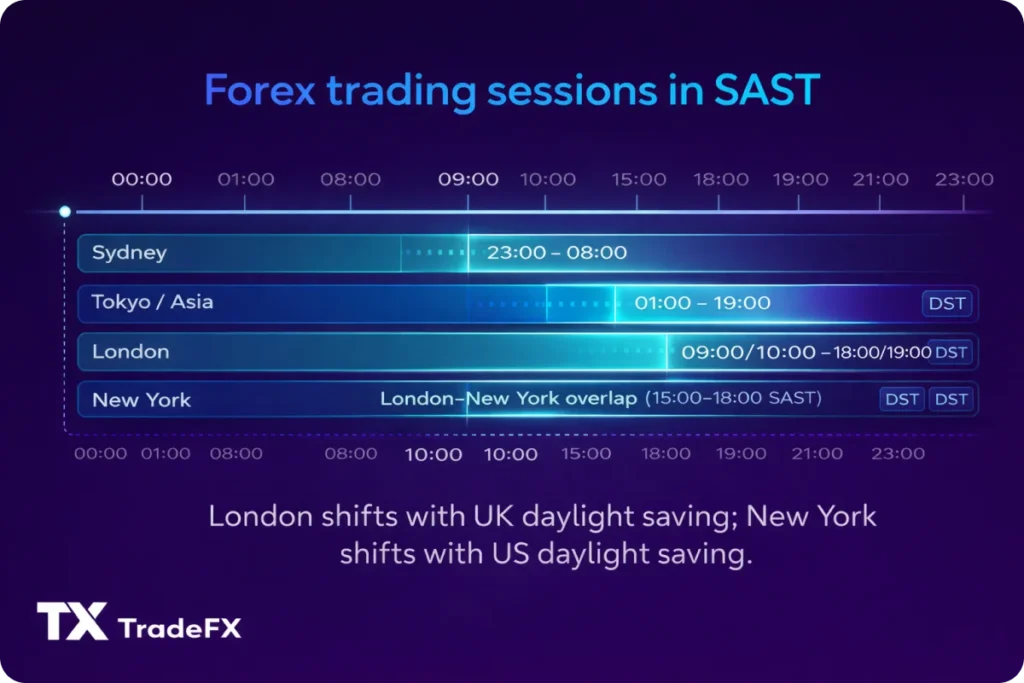
The result means your trading day in South Africa naturally syncs with the London open in mid-morning and peaks during the London–New York overlap in the late afternoon and evening.
Daylight Saving Quirks:
- When the UK moves clocks forward, London starts at 09:00 SAST.
- When New York moves clocks back, the overlap can stretch, making evening trades even more active for South Africans.
Picture this: it’s early morning in Cape Town, and the city is just beginning to wake up.
You’re ahead of London, which hasn’t opened yet, and the price action remains measured.
By mid-morning in South Africa, London hits the bell and liquidity surges.
Later in the day, as Cape Town winds down and dinner tables fill, New York traders step in, and the charts can light up with movement.
Because the world’s biggest financial hubs follow their schedules (due to time zones), you need to understand how global sessions align with South African Standard Time (SAST).
This guide will walk you through the trading sessions, their overlaps, and the specific opportunities they tend to create.
We’ll also look at which times work best for different trading styles, from scalpers chasing rapid moves to swing traders who prefer steady ranges.
If you want the full picture of when the market actually opens and closes in SAST, start with our detailed breakdown here: What time does the forex market open in South Africa?
Trader’s Takeaway:
You do not need to be awake for every single hour from Sydney to New York (that is simply impractical).
As a South African trader, the excitement only really begins when London opens and often ends when New York winds down.
Knowing these facts keeps you focused on the “best time” when liquidity, volatility and opportunity align.
The Four Major Forex Sessions
The forex market isn’t one endless stream of trades like you might think due to the 24-hour open statement.
Forex market hours explained by Investopedia show how each session overlaps and why timing matters.
It has four overlapping sessions, each shaped by the financial centres that drive it.
For South African traders, knowing the characteristics of each session matters just as much as knowing when it opens and closes.
Asian Session (Tokyo & Sydney) in South African Time
- SAST Hours: 01:00 – 10:00
- Character: Calm, range-bound, with fewer breakouts.
- Best for: Swing traders looking for steady entry levels.
- Key pairs: AUD/JPY, NZD/USD, USD/JPY.
- Local impact: Quiet for ZAR pairs, unless Asian equity markets jolt sentiment.
Full Content: Asian session time in South Africa
London Session in South African Time
- SAST hours: 09:00/10:00 – 18:00/19:00 (depending on daylight saving).
- Character: High liquidity and sharp volatility, especially on GBP, EUR, and ZAR pairs.
- Best for: Scalpers and day traders who thrive on movement.
- Key pairs: EUR/USD, GBP/USD, USD/ZAR.
- Local impact: This is when South Africans hit their trading stride — your working day overlaps with London’s open.
Full Content: London session time South Africa
New York Session in South African Time
- SAST Hours: 15:00 – 23:00
- Character: News-driven and volatile. Big US economic data (like non-farm payrolls) can swing markets hard.
- Best for: Day traders and news traders chasing momentum.
- Key pairs: USD/ZAR, EUR/USD, XAU/USD (gold).
- Local impact: Late afternoon to evening in SA is when the New York session brings fresh fire to the charts.
Full Full Content: New York session time South Africa
London–New York Overlap
- SAST Hours: 15:00 – 18:00
- Character: The most liquid and volatile stretch of the day.
- Best for: Scalpers, day traders, and anyone who needs movement.
- Key pairs: USD majors (EUR/USD, GBP/USD, USD/ZAR).
- Local impact: This overlap is the “sweet spot” for South African traders who want high activity without staying up all night.
According to the Bank for International Settlements’ FX liquidity survey, more than half of daily trading volume flows through London and New York, making their overlap the most active window globally.
GER30 (DAX) Trading Hours for South Africans
- SAST Hours: 09:00 – 23:00, with core activity peaking in the morning hours of London.
- Why it matters: Many South African traders love the DAX (GER30) for its volatility.
- Best for: Index traders looking for movement outside forex pairs.
Full Content: GER30 trading hours South Africa
Best Time to Trade Forex by Trading Style and Forex Pair
Not all traders chase the same kind of movement (or should we call it excitement?).
A scalper thrives on split-second volatility.
A swing trader looks for calm stretches where ranges hold steady.
The “best” time to trade forex isn’t universal or a one-size-fits-all.
It depends on how you trade, i.e., your trading style and what you trade (which forex pair).
Scalping
- Best Time: London–New York overlap (15:00 – 18:00 SAST).
- Why: Tight spreads, huge liquidity, and sharp intraday swings.
- Pairs to Watch: EUR/USD, GBP/USD, USD/ZAR.
- Takeaway: Scalpers should stick to peak activity. Outside of overlap hours, spreads widen and setups dry up.
Day Trading
- Best Time: London session (09:00/10:00 – 18:00/19:00 SAST).
- Why: Consistent volatility and plenty of intraday trends.
- Pairs to Watch: EUR/USD, GBP/USD, indices like GER30.
- Takeaway: Day traders in South Africa align perfectly with London hours — your working day is their busiest stretch.
Swing Trading
- Best Time: Asian session (01:00 – 10:00 SAST).
- Why: Quieter markets make it easier to identify support and resistance zones.
- Pairs to Watch: USD/JPY, AUD/JPY, NZD/USD.
- Takeaway: Swing traders can use the Asian calm to plan entries, then ride moves once London kicks in.
Position Trading
- Best Time: Less about sessions, more about key entry and exit points.
- Why: Position traders hold for weeks or months, but execution is smoother when liquidity is high.
- Pairs to Watch: Major USD pairs, gold (XAU/USD), and USD/ZAR.
- Takeaway: Even long-term traders benefit from entering during the London–New York overlap, when spreads are tightest.
Trader’s Takeaway:
Match your style to the session.
- Scalpers thrive on overlap chaos.
- Day traders excel in London’s rhythm.
- Swing traders find opportunities in the Asian calm.
- Position traders get the best fills when liquidity peaks.
Do you know where you slot in?
Factors that Influence the “Best Time” to Trade Forex
There isn’t a magic clock that guarantees profitable trading outcomes.
The trading process is a “game” of high probability outcomes.
Sessions establish the initial context, but the conditions within them can change rapidly.
When news breaks, liquidity decreases, and currency pairs react differently (any experienced trader will confirm this).
What works for one trader at 10 a.m. might be a dead market for another at the very same hour.
That’s why experienced traders don’t chase the clock.
They read the flow, the pair, and the context before clicking the buy/sell button.
Economic News Releases
Major news can transform a calm session into a tumultuous one.
- U.S. announcements like non-farm payrolls, Fed rate decisions, or CPI figures often shake markets during the New York session.
- UK and EU data (inflation, GDP, and ECB updates) hit hardest during the morning in London.
- South African Reserve Bank statements can spike USD/ZAR outside of global peaks.
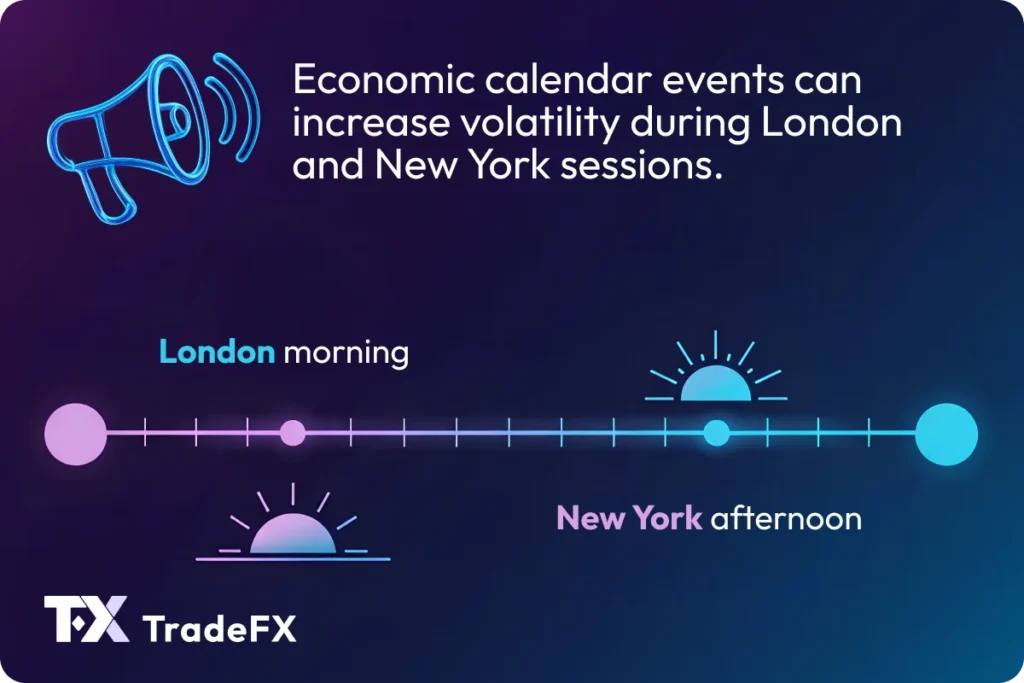
Major news releases drive volatility, especially in the London and New York sessions.
Tools like the Forex Factory economic calendar help traders in South Africa track these events in local time.
Currency Pairs
Not all pairs are equal across sessions.
- USD/ZAR: Most active when London and New York overlap.
- EUR/USD and GBP/USD: London and New York hours dominate.
- JPY crosses (USD/JPY, AUD/JPY): More active during Asian hours.
Time Zone & Lifestyle
We live in a busy world; practical reality matters.
- London opens mid-morning SAST, right when South Africans are active.
- New York stretches into the evening, which may suit night owls.
- The Asian session demands trading in the dead of night (tough unless you’re a swing trader planning levels).
Trader’s Takeaway:
The optimal trading time is a dynamic objective.
It depends on the news, which pairs you trade, and when you can be at your desk.
Sessions are the framework, but economic news, liquidity, and your lifestyle fill in the details.
Common Mistakes Trades Should Avoid
You can memorise every session’s time, mark your calendar, and know exactly when London and New York open.
But then real-life trading smacks you in the face.
The market is open, but nothing moves.
Spreads widen just as you enter.
You wake up early for Asian hours and spend three hours watching EUR/USD shuffle sideways.
Or worse: you miss a huge London breakout because you forgot the UK switched to daylight saving.
These examples aren’t theory; they’re scars most traders carry.
The good news?
Once you recognise them, they’re easy to avoid in most cases.
Here’s where South African traders often stumble and how to dodge those potholes:
Trading Dead Hours
Yes, the market is “open” 24/5, but “open” doesn’t mean “active”.
If you’ve ever sat staring at a chart during the Sydney afternoon (around 14:00 SAST), you know the pain.
Spreads widen, price ticks up and down without direction, and you leave with frustration instead of profit.
That isn’t trading… it’s bleeding slowly.
Forgetting Daylight Saving
This one catches even seasoned traders.
You get comfortable trading London at 10:00 SAST, then suddenly the UK shifts to summertime, and the market starts buzzing an hour earlier.
If you miss the opportunity, by the time you log in, the market move will have already occurred.
The same happens with New York in March and November.
One week you’re catching the overlap perfectly; the next week you’re showing up late to the party.
Overtrading Asian Ranges
South African traders often think (mostly due to influencer hype), “If the market’s open, I should trade.”
So they jump into the Asian session at 03:00 SAST, expecting prime-time action.
Instead, they find EUR/USD moving in a 15-pip box range for hours.
The result?
Overtrading: death by a thousand small losses.
The Asian trading hours are meant for planning rather than for aggressively buying and selling (most of the time).
Ignoring Your Body Clock
Markets punish those that lack focus.
Plenty of traders try to catch New York moves after a full day of work behind a desk in Johannesburg or Cape Town.
They sit at their desks half-asleep at 21:00 SAST, still waiting for an entry.
By the time the setup forms, discipline is gone, and they enter out of impatience.
That trade isn’t lost to the market; it’s lost to fatigue (sometimes happens to the best of us)!
Trader’s Takeaway:
The clock matters, but so do you.
Liquidity, volatility, and energy levels all need to line up.
The best trades come from active markets and when you’re focused enough to take advantage of them.
3 Rules for Timing Your Trades in South Africa
- Don’t chase dead hours – if spreads are wide and the price is flat, step back.
- Track daylight saving – London and New York won’t wait for you to catch up.
- Avoid Asian overtrading – use the calm to plan, not force entries.
- Respect your own energy – tired traders lose money faster than markets can move it.
Best Days to Trade Forex in South Africa
In forex, when you trade often matters as much as what you trade. From a South African perspective (SAST), the most dependable trading opportunities typically cluster around the middle of the week, a time when global liquidity and institutional participation are at their peak.
Tuesday to Thursday: The optimal trading period
These are consistently the most productive days for forex traders. By Tuesday, the market has absorbed weekend news and early-week positioning, allowing clearer trends to emerge.
During these days, the London and New York sessions overlap in SAST, creating deep liquidity, tighter spreads, and more decisive price action. Major economic data releases and central bank commentary also tend to land midweek, which fuels sustained movement rather than erratic spikes.
Monday: A slow ignition
Mondays often start cautiously.
Liquidity is thinner during the Asian and early London sessions as traders assess weekend developments and rebalance positions.
Price action can be choppy or range-bound, and false breakouts are more common.
While experienced traders can still find setups, Monday generally rewards patience over aggression.
Friday: Momentum fades, risk increases
Fridays begin with reasonable activity but often lose energy as the North American session progresses.
Many institutional traders reduce exposure ahead of the weekend, causing liquidity to dry up.
This can lead to sudden, less reliable moves—especially later in the day.
For South African traders, the early London and New York overlap on Friday can still offer opportunities, but holding trades late into the session carries added risk.
Best Trading Days of the Week
If you’re trading from South Africa, align your strategy with Tuesday to Thursday during the London–New York overlap.
That’s when the market is most honest—liquid, responsive, and driven by real participation rather than thin, nervous flows.
Forex doesn’t reward constant action.
It rewards timing—and midweek is when the global market shows its clearest hand.
The Market Has Its Hours: Do You Have Yours?
There isn’t a single “best” time to trade forex in South Africa.
London’s open, New York’s surging, and the overlap between the sessions presents windows of opportunity.
Your focus should be where liquidity and opportunity stack in your favour.
I have personally spoken to so many traders that “give back profits” due to the thin Asian hours, the daylight saving shifts, and the late-night fatigue (the burnout is real).
The edge comes from more than knowing the opening bell of each market session.
My advice to you: it comes from matching your trading style to the right session, watching how your chosen pairs behave, and being honest about your rhythm.
I’ve learnt that sometimes the hardest part isn’t looking for trading opportunities; it is waiting for the right ones.
So here’s the real question: when the next trading day begins and the markets open, will you be trading at your best time, or just trading because the clock says you can?
Key Takeaways: Best Time to Trade Forex in South Africa
- The London–New York overlap (15:00 – 18:00 SAST) is the most active and profitable window for South African traders.
- The London session (09:00/10:00 – 18:00/19:00 SAST) aligns perfectly with the South African workday and offers consistent opportunities.
- The Asian session (01:00 – 10:00 SAST) is quieter, best suited for swing traders planning entries.
- Always track daylight saving changes in London and New York to avoid missing key moves.
- Your trading style and personal rhythm matter as much as the clock: trade when the market and your mind are both sharp.