






The forex market’s movements (trends, consolidation, and ranges) vary throughout the day, as every forex trader should know.
There are trading hours when the price “moves sideways”.
The New York session sits at the heart of those busy hours.
It’s the final major trading session of the day, and when it opens, the world takes notice.
For South African traders, this session lines up in the afternoon.
This is a convenient window that avoids the late nights and early mornings other traders around the globe face.
The challenge?
Session times between New York and South Africa don’t always open and close at the same time year-round.
Daylight Saving Time in the United States shifts the opening and closing, while South Africa stays locked on SAST year-round.
That difference causes confusion for many local traders.
The main focus of this article is when the New York session actually runs in South African time.
That’s exactly what I will explain and answer in this guide.
You’ll see the official open and close times in SAST, how daylight saving in the US affects the schedule, and when overlaps with London create explosive moves.
We’ll also look at which forex pairs, commodities, and indices offer the best opportunities in this session.
I have also included strategies and practical tips that can help South Africans trade the New York session with more confidence.
No more guessing the hours.
No more confusion about time zones.
This is your clear map to trading the New York session in South Africa.
New York Session Time in South Africa
Knowing when the New York session starts and ends in South African time is the first step to trading it properly (don’t get your forex market sessions mixed up).
The official hours of the New York forex session are 08:00 to 17:00 Eastern Time (ET).
But there’s a catch: the United States observes Daylight Saving Time (DST).
That means session times shift twice a year, while South Africa remains fixed on SAST (GMT+2).
This mismatch creates confusion for traders who don’t adjust their charts or economic calendars.
Here’s how it works.
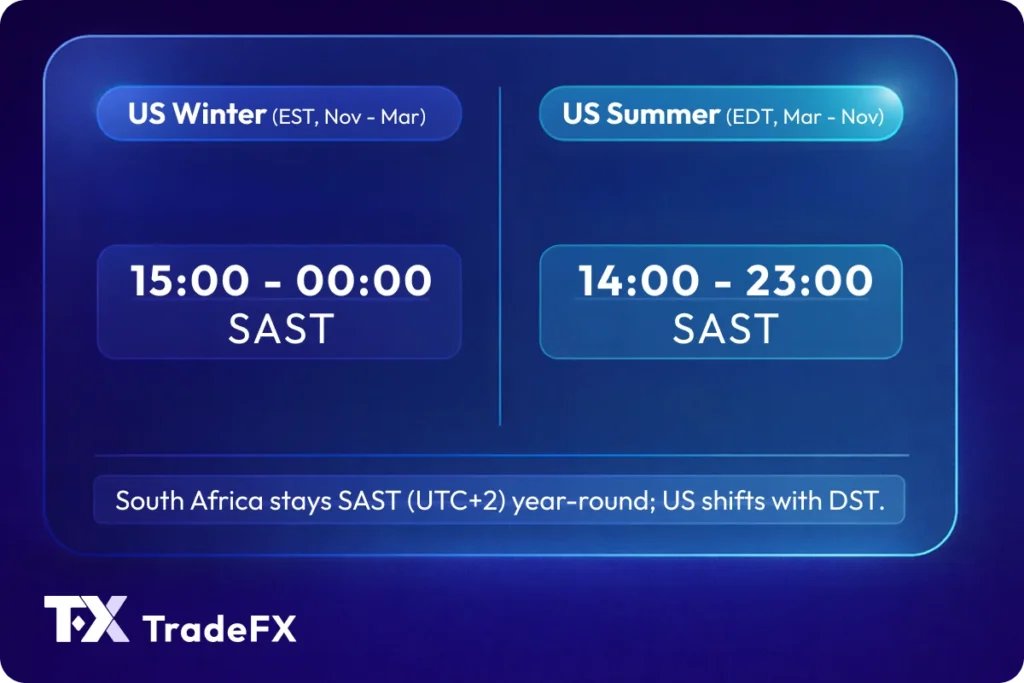
In the US winter months, from November to March, the New York session runs from 08:00 to 17:00 EST, which converts to 15:00 to midnight in South Africa.
During the US summer months, from March to November, the session still runs from 08:00 to 17:00 locally, but on EDT instead of EST.
That pushes the South African schedule one hour earlier, making it 14:00 to 23:00 SAST.
The overlap between London and New York delivers the highest liquidity of the day. This makes it a prime window for short-term traders. To compare how this timetable fits against other sessions, check our full article on the best time to trade forex in South Africa.
Here’s the simple breakdown:
New York Session Times in South Africa (SAST):
| Season | New York Local Time | South Africa Time (SAST) |
|---|---|---|
| US Winter (EST, Nov–Mar) | 08:00 – 17:00 EST | 15:00 – 00:00 SAST |
| US Summer (EDT, Mar–Nov) | 08:00 – 17:00 EDT | 14:00 – 23:00 SAST |
For South African traders, this means the New York open happens mid-afternoon, running into the evening.
The benefit is clear: you don’t need to stay up late or wake up before dawn to catch the open and London overlap.
This is also the main reason many South African traders plan their schedules around the London–New York overlap.
This is because it coincides with the peak of liquidity, volatility, and opportunity!
If you’re unfamiliar with this, you’ve been overlooking a significant opportunity that keeps South African traders glued to their screens!
What is the New York session in Forex?
The forex market is open around the clock (due to different time zones), but not every hour deserves your attention.
To make sense of the flow, the day is divided into four major trading sessions: Sydney, Tokyo, London, and New York.
Each has its character, with unique liquidity, volatility, and trading opportunities.
The New York session is the last of the four, beginning when US markets open and overlapping with Europe for several hours.
It is one of the most influential sessions, accounting for a large share of daily forex turnover.
What does the New York session refer to?
The New York session refers to the period when financial markets in North America, primarily in New York, are open for trading.
- New York Stock Exchange (NYSE)
- NASDAQ
When Wall Street opens, banks, hedge funds, and major institutions step in with heavy trading volume.
This creates sharp moves across major currency pairs, particularly those involving the US dollar.
Unlike the Asian session, which can be quieter, or the London session, which sets the early tone, the New York session is often defined by decisive trends, high-impact news, and market-moving events.
For South African traders, the importance of this session is two-fold.
- This session provides traders with access to the most liquid currency pairs at a convenient time that aligns with their local working hours.
- This session coincides with the London session, fostering some of the world’s busiest and most profitable trading conditions.
For South African traders, this is a golden window.
Not only is the US dollar at the centre of global forex, but the session lines up with the South African afternoon, making it both convenient and powerful.
Midday coffee, anybody?
Think of the New York session like the sun in the forex universe.
The New York session radiates its influence and provides warmth to the financial landscape, while the South African afternoon serves as a convenient oasis where investors can harness this energy, allowing their opportunities to flourish.
London–New York Session Overlap in South Africa
The overlap between the London and New York sessions is my personal favourite trading session, as it is when the real action happens.
For a few hours a day, the two largest financial centres in the world are open at the same time.
Liquidity is at its highest, spreads tighten, and volatility often surges.
This period is so opportunistic that many traders skip the rest of the day and only trade the overlap.
For us South African traders, the timing is ideal.
In the US summer months (March to November), the overlap runs from 14:00 to 18:00 SAST.
In the US winter months (November to March), it shifts one hour later, from 15:00 to 19:00 SAST.
Additionally, this coincides with the release of the most significant US economic data.
These hours often witness the release of non-farm payrolls, CPI, GDP, and interest rate decisions.
The result: sudden bursts of volatility that can drive sharp moves in the US dollar, gold, and equity indices.
For traders who thrive on momentum, the overlap is their time to shine.
But it’s not just about excitement.
The overlap is also when price discovery is most efficient.
Best Trading Hours for South African Traders
The New York session runs for nine hours, but only part of that window deserves your time.
For South African traders, there are two windows of golden opportunity.
You’ve guessed correctly.
The first is right after the New York session opens.
From 14:00 to 16:00 SAST in summer and 15:00 to 17:00 SAST in winter, markets often react sharply as US traders position themselves for the day.
This period can bring momentum trades, sudden breakouts, and reversals driven by the opening flow of orders.
The second, and most important, is the London–New York overlap.
This is the main event of the day.
From 14:00 to 18:00 SAST in summer, or 15:00 to 19:00 SAST in winter, both financial hubs are active at once.
This is when liquidity peaks, news hits, and volatility is at its highest.
Big moves in EUR/USD, GBP/USD, and gold often happen in this stretch.
Outside these hours, the market tends to slow drastically.
Late in the evening, volume thins out, spreads widen, and opportunities often fade.
The smart approach (not always the easiest) is discipline: focus only on the hours when liquidity and volatility align.
Currency Pairs and Assets to Trade During the New York Session
The US dollar dominates the New York session.
This is not surprising.
That makes USD pairs and dollar-related assets the most active and liquid instruments for South African traders.
EUR/USD remains the most traded currency pair in the world, accounting for approximately 23% of daily forex volume as of 2025.
Major Forex Pairs
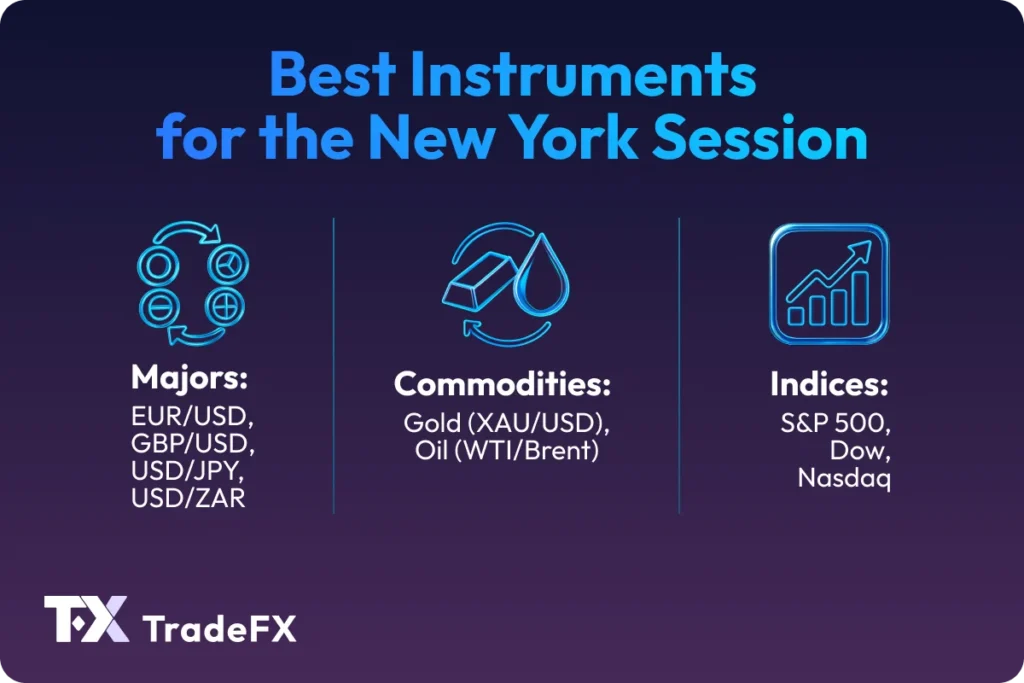
The bulk of forex volume during New York hours flows through the majors.
- EUR/USD: The most traded pair in the world. The pair exhibits high liquidity, makes sharp moves during overlap hours, and is often influenced by both European and US data.
- GBP/USD: Known as “Cable”, it reacts strongly to economic releases from both London and New York, creating powerful intraday swings.
- USD/JPY: A favourite during US hours, especially when risk sentiment shifts. It often moves with equities and US yields.
- USD/ZAR: Locally relevant. Liquidity increases in New York hours, but spreads can widen on volatile days.
Commodities
Commodities priced in dollars see some of their most explosive moves when US traders step in.
- Gold (XAU/USD): Extremely active in New York, especially around US data releases. Moves can be fast and decisive.
- Oil (WTI, Brent): Priced in US dollars, oil markets respond to American supply/demand data and geopolitical headlines.
Indices
Equity indices are another cornerstone of the New York session, just like the GER30 during the European session.
The open on Wall Street often sets the tone for global risk sentiment, with knock-on effects across forex and commodities.
- S&P 500, Dow Jones, Nasdaq: Equity indices drive risk sentiment. Moves here often spill over into forex pairs and commodities.
For South African traders, the key is to stick with instruments that combine liquidity and volatility.
Majors and commodities provide clean price action with tighter spreads.
Exotics, like USD/TRY or even some rand crosses, can widen dramatically in New York hours and are best avoided unless you have a specific edge.
In short, traders tend to focus on USD majors, gold, and US indices.
They move most, move cleanest, and offer the best opportunities when New York is in play.
Strategies for Trading the New York Session in South Africa
The New York session is rich with opportunity, but trading it without a plan will be costly.
There just are no two ways about it.
For South African traders, these four strategies stand out and should be taken into account during the New York session.
1. Momentum at the Open
- The first hour after New York opens can be explosive.
- Liquidity floods in as US traders step into the market, driving sharp bursts of movement.
- This makes it a prime time for momentum plays i.e. breakouts from overnight ranges, early reversals, or gap fills.
Why it matters: catching momentum at the open allows you to enter trades when volume is highest and trends are forming, instead of chasing moves later in the day.
2. News Trading
- The US releases most of its high-impact data during the New York session.
- Non-Farm Payrolls, CPI, GDP, and interest rate decisions often hit in the overlap window.
- These events can spark sudden spikes that redraw the trading landscape in minutes.
Why it matters: if you’re prepared, news can offer some of the fastest profit opportunities of the week. If you’re not, it can wipe out a day’s gains in seconds. Knowing how to handle these releases separates disciplined traders from gamblers.
3. Breakout and Continuation Trades
- The London–New York overlap is the busiest time in global forex.
- Consolidation zones built earlier in the day often break, with moves more likely to follow through than fade.
Why it matters: trading during this window means you’re aligning with maximum liquidity. Moves here are cleaner, spreads are tighter, and trends are more reliable than in quieter hours.
4. Risk Management in Volatile Hours
- Opportunity comes with risk.
- During New York news releases, spreads can widen, and slippage is common.
- Leverage that feels manageable in quiet conditions can be devastating here.
Why it matters: the New York session can deliver some of the biggest winners of the week. But only if you survive the losers. Smart risk control keeps you in the game long enough to benefit from the big moves.
With discipline and the right approach, the New York session can turn from chaotic to consistent.
Consistency is the name of the game!
Practical Tips for South African Traders
Even when understanding the concept of session times, many South African traders still make unnecessary mistakes when it comes to trading the New York window.
A few practical adjustments can make all the difference.
Tick these boxes.
This table breaks down the key things to remember:
| Tip | Why It Matters |
|---|---|
| Check Your Broker’s Server Time | Brokers often use GMT, London, or New York server times instead of SAST. Always confirm the platform time against local time, especially during March and November when the US adjusts clocks. |
| Use an Economic Calendar | The New York session is driven by US news. Track events like NFP, CPI, and FOMC announcements. These can instantly shift market direction. |
| Plan Your Day Around Key Windows | Focus only on the New York open and the London–New York overlap. These are the hours with the cleanest setups, highest liquidity, and best opportunities. |
| Avoid Overtrading Quiet Hours | Late evenings bring thin liquidity and wider spreads. Most traders lose money forcing trades in these conditions. Protect your earlier profits. |
| Lifestyle Advantage | The session runs in the South African afternoon and evening. This lets you trade during natural waking hours, unlike traders in Asia who must stay up at night. |
By following these tips, you cut out common mistakes and trade the New York session on your own terms!
Wait…
Bonus Tip: Use New York Close Charts
Most brokers show daily charts that split the trading week into six or seven candles, depending on their server time.
New York close charts are different: they align daily candles with the 5 p.m. EST close, creating a true five-day week.
For price action traders, this matters.
It produces cleaner candlestick patterns, more reliable support and resistance levels, and better technical signals overall.
To take advantage, choose a broker or platform that uses a data feed synced to the New York close.
Mastering the New York Session in South Africa
The New York session isn’t just about knowing the clock.
It’s about showing up when the world’s biggest players step into the market.
When Wall Street opens, liquidity surges, volatility spikes, and opportunities appear that simply don’t exist at other times of the day.
For South African traders, this is a gift.
While others in Asia stay up past midnight, and traders in the US juggle early mornings, you get the luxury of trading the most important session in your afternoon.
But here’s the catch: the edge only exists if you treat these hours with focus.
Two or three quality trades in the overlap can shape your entire week.
Chasing setups outside of these windows only leads to fatigue and losses.
Mastering the New York session means mastering discipline.
It’s about waiting for the right moment, acting with conviction, and stepping aside when the market goes quiet.
Do that consistently, and you’ll stop fighting the market and start trading with it.
This is the power of timing.
This is the edge that turns South African traders from random into consistent.
The real question is: are you ready to capitalise?
Key Takeaways: New York Session Time in South Africa
Session Hours (SAST):
- US Winter (EST, Nov–Mar): 15:00 – 00:00
- US Summer (EDT, Mar–Nov): 14:00 – 23:00
London–New York Overlap:
- 15:00 – 19:00 SAST in winter
- 14:00 – 18:00 SAST in summer
- This period offers the highest liquidity and volatility of the day.
Best Trading Windows:
- First 1–2 hours after the New York open → momentum trades and reversals.
- London–New York overlap → strongest moves, news releases, cleanest setups.
Top Instruments to Trade:
- Forex Majors: EUR/USD, GBP/USD, USD/JPY, USD/ZAR
- Commodities: Gold (XAU/USD), Oil
- Indices: S&P 500, Dow Jones, Nasdaq
Strategies That Work:
- Trade early momentum.
- Position around US news events.
- Look for breakouts and continuations during overlap.
- Keep risk tight during volatile spikes.
Practical Tips:
- Confirm broker server times against SAST.
- Use New York close charts for cleaner price action.
- Avoid overtrading in late, thin markets.
- Take advantage of South Africa’s natural alignment with afternoon trading hours.